FALL 2025 NEWSLETTER

MENU


Recovering Damages From Water Diversion


-84f7ef4c82f1bdb91065560d1d45d14df5ebcc83.png?v=02262024142437)

The history of real property law is replete with litigation over how one property owner’s assertion of their rights to control and adapt their property impacts their neighbors. These cases usually involve damage to a neighboring property resulting from acts of so-called trespass—which might better be termed a nuisance—one of the most common being damage caused to one property through the drainage or manipulation of surface water by a neighbor.
This damage might be from an uphill owner redirecting water in a way that floods their downhill neighbor, or even a downhill neighbor who artificially blocks the flow of water across their land, leaving such water to damage their uphill neighbor. Moreover, particularly in New York City, where water damage results from neighboring construction, strict liability may also apply.
While the basic rules governing these cases have been well defined by the Court of Appeals for almost 150 years (see Barkley v. Wilcox, 86 N.Y. 140 (1881)), it is still a remarkably fluid area of law, with Appellate Court decisions constantly refining the boundaries of where liability may be imposed when the surface water from one property damages another.
The General Rules of Water Diversion
“The rule in New York governing the rights of owners of property with respect to diffused surface water is ancient and authoritative, predicated on two Latin maxims:… aqua currit et debet currere, ut currere solebat (Water runs and ought to run, as it has used to run); cujus est solum, ejus est usque ad coelum et ad inferos (Whose is the soil, his it is even to the skies and to the depths below).” Musumeci v. State, 43 A.D.2d 288, 290 and n1 (3rd Dept. 1974).
Diffused surface water—i.e. “water from rains and melting snows”—is considered a common enemy among all landowners. Barkley, 86 N.Y. at 142. See also Stormes v. United Water New York, Inc., 84 A.D.3d 1352, 1353 (2d Dept. 2011) (“Surface waters are defined as an ‘accumulation of natural precipitation on the land and their passage thereafter over the land until it either evaporates, is absorbed by the land, or reaches stream channels…Surface waters can also form as a result of flood waters detaching from the main current and spreading over land where they remain’”) (citations omitted); Musumeci, 43 A.D.2d at 290 n. 2 (New York law regarding surface water is “more properly called common-enemy rule…because diffused surface water is considered a common enemy which each owner may fight off or control as he is able”).
In 1881, the Court of Appeals in Barkley was confronted with the task of adopting a definitive rule on this subject. In addressing the rights of property owners concerning surface water flow, the Barkley court drew a strong distinction between the rights of a property owner to direct or dam the flow of surface water and rights concerning naturally flowing waterways, like surface streams and rivers.
As discussed in more detail below, when it comes to addressing surface water, a property owner has the absolute right to take whatever measures it wants to control or staunch the gathering of surface water on their property so long as it is done as part of (1) “improvements made in good faith to fit one’s property to some rational use” and (2) as the diffused surface water is not drained into another’s property by means of artificial pipes and ditches.” Musumeci, 43 A.D.2d at 291 citing Kossoff v. Rathgeb-Walsh, Inc., 3 N.Y. 2d 583, 589-590 (1958).
A Landowner May Not Divert or Block Rivers and Streams to the Detriment of a Neighbor
With respect to naturally occurring waterways such as rivers and streams—as opposed to surface water—the Court of Appeals in Barkley stressed that streams and the like may be used by the owner of any land over which such water passes, but the water itself is not “owned,” and the landowner may not prevent the water from continuing to flow past his property and onto a neighbor's because the owners of land on a water course, are not owners of the water which flows in it. But each owner is entitled by virtue of his ownership of the soil, to the reasonable use of the water as it passes his premises, for domestic and other uses, not inconsistent with a like reasonable use of the stream, by owners above and below him. Such use is incident to his right of property in the soil. But he cannot divert, or unreasonably obstruct the passage of the water, to the injury of other proprietors. (emphasis added). The Court of Appeals then noted that “[t]hese familiar principles, are founded upon the most obvious dictates of natural justice, and public policy. The existence of streams is a permanent provision of nature, open to observation, by every purchaser of land through which they pass.”
A Landowner May Take Certain Steps to Combat Surface Water, Even to the Detriment of a Neighbor
By contrast to the obligation to allow a river to continue to flow across one’s property, the Barkley court noted that “the law has always recognized a wide distinction, between the right of an owner, to deal with surface water falling or collecting on his land, and his right in the water of a natural water-course.”
In Barkley, rain regularly gathered on the plaintiff’s lot before flowing onto the neighboring defendant’s property. The defendant used earth from construction of a house to fill in indentations, grade, and improve his property and the sidewalk in front of it; and, as a result, water pooled and damaged the plaintiff’s property.
In affirming judgment for defendant, the Court of Appeals held that it was in the public interest of cultivation and land improvement that a landowner must have the right to improve his land by preventing surface water from flowing over it or gathering, even if doing so would cause the water to be retained by the uphill landowner.
The court was careful to note that this rule does not allow for a lower landowner to, by artificial means, collect and divert surface water onto a neighboring property writing that “before [surface water] leaves his land and becomes part of a definite water-course, the owner of the land is deemed to have an absolute property, and he may appropriate it to his exclusive use, or get rid of it in any way he can, provided only that he does not cast it by drains, or ditches, upon the land of his neighbor, and he may do this, although by so doing he prevents the water reaching a natural water-course, as it formerly did, thereby occasioning injury to [neighboring properties].” (emphasis added).
In distinguishing improvements that staunch surface water pooling on one’s property from those that intentionally redirect water onto another property, the Barkley Court explained that “[t]here is a manifest distinction between casting water upon another’s land, and preventing the flow of surface water upon your own.” See also Bennet v. Cupina, 253 N.Y. 436, 428-39 (1930) (reconstruction and elevation of defendant’s driveway, which caused surface water to flow onto plaintiff’s property was not unlawful because “[s]ince this water is not cast by drains or ditches upon adjoining premises defendants may get rid of it any way they can….The resulting damage gives no right of action); Kossof, 3 N.Y.2d at 589-90 (no liability where defendant upper landowner’s improvement of adjoining lot by paving the surface area in connection with the construction of a gasoline station resulted in water leakage through the wall of plaintiff lower landowner’s building and property damage, because plaintiff had no “right to insist that the upper owner shall keep his land in its natural state, so that the surface water may percolate into the ground without flowing upon plaintiff’s land as it would be more likely to do after being improved.”). C.f. Buffalo Sewer Authority v. Cheektowaga, 20 N.Y.2d 47, 52 (1967) (defendant town’s use of basins and a drain system to redirect water into plaintiff’s system was “rather…that of a proprietor artificially collecting and concentrating large quantities of surface waters and discharging them into an outlet on another’s land unable to carry them off” and so it was liable for the damage to plaintiff).
The Appellate Departments Vastly Expands the Definition of “Artificial Means” to Include Culverts, Berms and the Expansion of Existing Water Routes
In the years since Buffalo Sewer, although still maintaining a landowner’s right to prevent surface water from gathering on their own property, the Appellate Divisions have slowly but surely expanded the definition of “artificial” means beyond the diversionary “drains, pipes, or ditches” specifically precluded by the Court of Appeals.
Establishing ‘Time Is of the Essence’ and Performing at a ‘Time Is of the Essence’ Closing

John M. Desiderio
-ffbed8675f53ad8af85dd10600b4a442e8119967.png?v=10072025193549)
As the authors noted in our first article on Time of the Essence (TOE) Closings, “real estate closings may be the most basic and common real estate experience, but the familiarity ends once a provision of the contract of sale has been breached.” See Bailey and Desiderio, Enforcing the Contract—Obtaining Down Payment or Specific Performance (New York Law Journal, March 8, 2006). This is because the circumstances attending each purchaser’s or seller’s failure to close on the TOE closing date is always unique, and this has resulted in an innumerable variety of judicial decisions applied to ever-changing real estate scenarios.
Nevertheless, nearly 20 years later, despite ever-changing circumstances, the rules that govern TOE closings remain essentially the same. “[W]hen a party to a real estate contract declares time to be of the essence in setting a closing date, each party must tender performance on that date, and a failure to perform constitutes a default.” Donerail Corporation v. 405 Park LLC, 100 AD3d 131, 137 (1st Dept. 2012). (Emphasis added).
Further, “[i]t is well-settled that absent a breach on part of the seller, a purchaser who defaults on a real estate contract without lawful excuse cannot recover its down payment.” Id. (Emphasis added). And, more recently, In 361 Broadway Associates v. Morales. 195 AD3d 497 (1st Dept 2021), the First Department restated the rule, holding that:
Plaintiff seller met its initial burden by presenting evidence of the agreement and that it was ready, willing, and able to close on the properly notified closing date,” and the “Option Agreement [which contained a TOE Closing date clause] expressly provided that if [purchaser] defaulted and ultimately failed to close, [seller] was entitled to keep the deposit.”
However, not all real estate contracts start off with a TOE clause. When a seller and buyer enter into a contract of sale for real property, and the contract does not specify a date certain on which the closing will occur, the contract normally states that the closing shall occur “on or about” a certain date. This is because there are usually several uncontrollable factors that affect each party’s ability to prepare for the closing, and neither party can know when each of them will actually be “ready, willing, and able” to close.
Under these circumstances, the parties may mutually agree to adjourn the “on or about” closing date, to accommodate each other’s needs. Nevertheless, even when they cannot agree, either party is entitled to a reasonable adjournment of the closing date. See Zev v. Merman, 134 AD2d 555 (2d Dept. 1987), affirmed 73 NY2d 781 (1988). In addition, in connection with sponsor-generated purchase contracts, for new condominium or cooperative units, the sponsor usually reserves the contractual right to adjourn the closing date at will. This is because of the many issues that can arise in the course of construction, which will delay completion of the building and/or its individual units and, in turn, delay issuance of the temporary certificate of occupancy (“TCO”) which is required before the closing on a particular unit may occur. See, e.g., 361 Broadway Associates Holdings, supra.)
Nevertheless, occasions arise when either the seller or the buyer to a real estate contract, which does not contain a TOE Closing Date, will want to speed the transaction to completion. It may then be necessary to convert an “on or about” contract into a TOE contract, because either the buyer or the seller defaults on the agreed “on or about” date and/or because the adverse party is suspected of engaging in disingenuous conduct to either unduly delay the closing or to possibly create a fallacious excuse to back out of the contract. See, e.g., Martocci v. Schneider, 119 AD3d 746 (2d Dept. 2014) (when the closing did not take place on the original closing date, the seller then scheduled a TOE Closing, the buyer presented pretextual reasons for not appearing on the TOE Closing date, and “the sellers satisfied their prima facie burden of demonstrating that they were ready, willing, and able to perform on the [TOE} closing date.”).
The Basics of Converting ‘On or About’ to ‘TOE’
The party desiring to schedule the TOE Closing must give written notice (the “time of the essence letter”), to the adverse party, declaring that the closing will occur on a date, place, and time certain, which will be “Time Is of The Essence.” Although it is preferable that the words “Time is of the Essence” be present within the “time of the essence” letter, the notice will still constitute a proper TOE notice, without those words, so long as the letter does advise the other party that it will be in breach of the contract, if the closing does not occur on the TOE date, and (a) if the buyer defaults, that the defaulting buyer will forfeit its down payment deposit for not closing, or (b) if the seller defaults, that the buyer will be entitled to commence an action for specific performance. See ADC Orange, Inc. v. Coyote Acres, Inc., 7 NY3d 484 (2006). (held: “[T]he mere designation of a particular date upon which a thing is to be done does not result in making that date the essence of the contract.) See also Bailey and Desiderio, Defining When “Time is of the Essence” (New York Law Journal, 5/9/2007).
The ”time of the essence” letter must schedule a “reasonable adjournment” of the closing date – one which, under the particular circumstances, may be deemed to give the defaulting party “a reasonable time to perform” the term or terms of the deal, which, as an excuse for not performing on the original closing date, the defaulting party may claim it cannot satisfy. See Coyote Acres, supra. Generally, attorneys will schedule the TOE Closing to occur thirty days after the date of the TOE letter.
However, there is no statute or court decision which requires a 30-day waiting period before conducting the TOE Closing. “Reasonableness” is determined on a case-by-case analysis. See Zev v. Merman, supra, in light of the nature and object of the deal as well as the previous conduct of the parties throughout the transaction. See, e.g., Miller v. Almquist, 241 AD2d 181 (1st Dept. 1998). In 2626 Broadway LLC v. Broadway Metro Associates, L.P., 85 AD3d 456, 457 (1st Dept. 2011), the court held that “a three-week’s written notice was reasonable under the circumstances.”
The ‘Performance’ Factors
At any real estate closing, but particularly at a TOE closing, the seller must demonstrate that it owns the property and that it has the ability to sell the property and deliver marketable title. See Bosco, Bisignano & Mascolo, Esqs. LLP v. Turyan, 8 AD3d 418 (2d Dept. 2004). Moreover, the seller must be ready to vacate at closing by hiring movers to actually vacate the premises to show that it was willing and ready. See Zev v. Murman, supra. On the other hand, first and foremost, the buyer must demonstrate that it has the ability to fund the balance of the purchase price due at the closing. It must show sufficient liquid assets to cover the differential between the loan amount and the contract price.
Non-Financial Pre-Conditions to Closing
As important as it is for the seller to be able to deliver marketable title, and for the buyer to be able to deliver the balance of the purchase price, to prove each party’s readiness to perform its contractual obligations at closing, a party’s ability to show itself ready, willing, and able to close, is also dependent upon the non-financial obligations it incurs under the written terms of the contract. Satisfaction of non-financial terms of the contract is also crucial in determining whether one or the other of the parties was “ready” and “able” to close on the scheduled TOE Closing date.
In Coyote Acres, supra, the Court of Appeals noted that the sale was conditioned upon the buyer’s obtaining subdivision and site plan approval from the town planning board for construction to be done on the subject premises. The court held that, for failing to set a TOE date for an interim payment due towards the purchase price, the seller was not entitled to retain the buyer’s downpayment because of only a two week delay in making that interim payment.
However, the court also held that the buyer was not entitled to specific performance, because, having failed to obtain the required government approvals, within the time specified in the contract, despite having obtained them eventually, buyer had nevertheless failed to carry the burden of showing that “it was ready, willing, and able to fulfill its contractual obligations” on the closing date.
In Grace v. Nappa, 46 NY2d 560, 564 (1979), a contract with a TOE clause, required the seller to produce “a recordable mortgage ‘estoppel certificate,’ to establish the outstanding balance of a mortgage encumbering the property.”
The Court of Appeals held that “[w]here a search of the title reveals an undischarged mortgage, a buyer is entitled to compliance with a contract provision requiring the seller to produce a certificate, in recordable form, demonstrating the outstanding balance of the mortgage accompanied by other pertinent information.”
Although the seller did not produce the required certificate “by law day,” seller attempted to prove the outstanding balance of the mortgage by producing canceled checks and an amortization schedule. The buyer refused to accept the checks and amortization schedule and other proposed substitutes for the certificate, and insisted on nothing less than what the contract required.
The Court of Appeals explained that the contract provision entitling the buyer to an estoppel certificate was a material term of the contract which excused the buyer’s performance and gave him the right to recover his down payment and the reasonable cost of the title search.
More recently, in Angelo Gordon Real Estate Inc. v. Benlab Realty LLC, 216 AD3d 420 (1st Dept 2023), the First Department followed Grace in a matter where the parties executed eleven interdependent contracts (“PSAs”) for several Manhattan properties which contained commercial tenants. The interdependent PSA’s provided that the mutual obligation to close was conditioned on simultaneous closings of the properties. If sellers failed to make a conforming tender under any of the eleven interdependent PSA’s, the plaintiff buyer was entitled to receive a refund of its deposit plus interest.
As a condition precedent to buyer’s obligation to close, the sellers were required to produce, at closing, tenant estoppel certificates which certified that:
Neither Tenant nor Owner-Landlord is in breach or default under the Lease, and Tenant knows of no event which, with the passage of time or the giving of notice or both, would constitute a breach or default under the Lease by Tenant or Owner-Landlord. (Emphasis added)
Instead of providing tenant estoppel certificates, the seller defendants [which the contract permitted them to do] “provided sellers’ estoppel certificates for certain of the commercial tenants,” but the First Department held the plaintiff was entitled to summary judgment because the sellers had breached a material obligation of the contracts. The court noted that “the sellers’ estoppel certificates stated that the owner-landlord was not in default under the lease, but, contrary to the requirements [of the contracts], omitted the language that the tenants were not in breach or default under the lease.” (Emphasis added).
In addition, the court noted that the sellers had not only waived, but had actually refused to seek the opportunity to cure, and that “defendants’ failure to tender conforming estoppel certificates meant they were not ‘ready, willing and able to close’ on the closing date, thus excusing plaintiff from performing under the PSAs,” and entitling it to refund of its $12 Million deposit, plus interest.
Conclusion
Accordingly, it is important that practitioners take especial care in drafting their own clients’ real estate contracts, and in reviewing the contracts drafted by the other party’s attorneys, to consider under what terms and conditions one or the other of the parties (a) will be deemed to have either been, or not been, ready, willing, and able to perform its contractual obligations at closing, or (b) will either want to expressly declare a non-financial pre-condition to closing to be “time is of the essence.,” or require that the non-financial pre-conditions be subject to reasonably foreseeable circumstances which permit the seller or the buyer, as the case may be, an opportunity to extend the time otherwise required to satisfy the condition.
Giving the attention such issues require will likely prove well worth the effort when and if a dispute develops over whether one or the other of the contracting parties claims a default based on failure to meet a Time is of the Essence condition upon which performance or non-performance of the contract will be judicially determined.
Adam Leitman Bailey is the founding partner of Adam Leitman Bailey, P.C., and John M. Desiderio is partner and Chair of the firm’s Real Estate Litigation Group. Niaz Najafi, a firm extern and third-year student at the Maurice A. Deane School of Law
The Appellate Division, First Department, Declared That the Apartment Unit’s Purchase/Sales Price Could Not Be the Sole Factor in Rejecting a Purchaser

Adam Leitman Bailey, P.C., was retained to represent an elderly couple who wished to sell their cooperative in Manhattan so that the husband could receive treatment elsewhere. While the couple found a buyer willing to purchase the unit for its fair market value, the application was rejected by the cooperative board because it has set an unwritten policy setting a minimum sale price floor. After the unit remained on the market for an extended period of time, the couple brought suit against the cooperative alleging breach of contract and breach of fiduciary duty. The board sought to dismiss the suit, and when its motion was rejected, it answered and moved for summary judgment to dismiss the breach of contract claim before the couple was able to conduct any discovery. The board used the fallback position that its activities were protected by the business judgment rule. It also sought a judgment declaring that the board may consider a unit’s purchase price when deciding to grant or withhold consent to a sale. Adam Leitman Bailey, P.C., countered by arguing that the breach of contract claim should stand because there was a dispute as to whether the sum demanded by the board to approve the sale reflected the true market value or constituted an improper restraint on trade.
Additionally, Adam Leitman Bailey, P.C., argued that the board was not entitled to a declaratory judgment because, while the couple agreed that price could be considered, it could not be the sole factor to consider. The Appellate Division agreed noting that the board’s contention did not raise a judicable controversy.
The Appellate Division, First Department declared that the apartment unit’s purchase/sales price could not be the sole factor in rejecting a purchaser.
Jeffrey R. Metz represented the Plaintiffs on appeal.
Adam Leitman Bailey, P.C., Obtains Dismissal of HP Proceedings and Wins Access Holdover Proceeding Against Nightmare Rent Controlled Tenant

Vladimir Mironenko
In New York City, residential leases generally require tenants to provide their landlords access to apartments to inspect, or to perform needed repairs and improvements. The Housing Maintenance Code prohibits tenants from refusing an owner or their agents access to an apartment to make repairs or improvements, or to inspect the apartment to determine compliance with law. Other laws require tenants to provide access after notice by their landlord. Rent stabilization and rent control laws allow for eviction of a tenant for unreasonably refusing access. The Housing Maintenance Code provides grounds for summary eviction proceedings following a tenant’s unreasonable refusal to provide access.
New York City landlords can find themselves in a frustrating position when tenants claim required repairs, obtain housing violations, commence HP proceedings, withhold rent, or file rent reduction proceedings, while simultaneously refusing the landlord’s workers access to the apartment or placing unreasonable conditions on access.
One New York City landlord encountered such a tenant. This rent-controlled tenant claimed extensive repairs were needed in her apartment. She called 311 resulting in the issuance of numerous Department of Housing Preservation and Development (HPD) violations. She filed Division of Housing and Community Renewal (DHCR) rent reduction and harassment applications. She commenced HP proceedings seeking imposition of fines upon the owner for not performing repairs.
In the meantime, despite the landlord’s efforts to arrange access to the apartment to effectuate repairs, the tenant refused to schedule meaningful access dates, tormented and harassed workers when she did allow access, cut access days short after verbally assaulting workers, interfered with worker’s efforts to effectuate repairs, and imposed unreasonable demands, including prohibiting workers of the landlord’s choosing to enter her apartment.
The landlord turned to Adam Leitman Bailey, P.C., for help. First, we appeared in the tenant’s several HP proceedings and filed detailed responses to the tenant’s DHCR rent reduction and harassment filings. In the HP cases, the tenant became argumentative with the court, refused to conference the matters with the HPD attorney assigned to the case or the court attorney, yelled at and threatened the judge, and, while demanding repairs, refused to discuss scheduling required access to the premises. Both HP proceedings were dismissed by scathing court decisions, including findings that, “[tenant] fails to appear before the court at counsel table and seeks to disrupt the court room and court room proceedings. [Tenant] is unwilling to discuss the substantive issues of her case and therefore this matter is dismissed.”
While the HP proceedings were dismissed, the landlord still had a problem, specifically, numerous pending violations. The landlord had to go on the offensive. We sent the tenant access letters in accordance with appliable laws, designating access dates for repairs. When the tenant again failed to provide access, we served the tenant with a Notice to Cure setting a deadline for compliance. When the tenant still failed to comply, we served a notice terminating the tenancy and commenced a summary holdover eviction proceeding.
In court, the tenant resorted to the same behavior. She argued and fought with court personnel, including court officers and court attorneys, and even the judge. She refused to discuss the case. She issued letters accusing the court of violating her rights. The court referred the tenant to Adult Protective Services; the tenant did not cooperate with them either.
We pressed the case forward and prepared for trial, preparing a witness and extensive documentation to demonstrate both the landlord’s attempts to gain meaningful access to the apartment and the tenant’s refusal to cooperate. After more outbursts, personal threats against the judge, and a refusal to participate in the proceedings, court officers were forced to escort the tenant outside of the courtroom.
We proceeded with an inquest and proved the landlord’s case. After inquest, the court awarded our client a final judgment of possession and a warrant of eviction against the tenant, execution of which the court temporarily stayed to allow the tenant a final opportunity to provide access. The court awarded the landlord such continuing access as necessary to correct all violations, and permitted the landlord to obtain and execute the warrant should the tenant refuse access or inhibit meaningful repairs during access hours.
Vladimir Mironenko, co-managing partner of Adam Leitman Bailey, P.C.’s landlord-tenant group, represented the landlord in the HP and DHCR proceedings and the Housing Court eviction proceeding.
Adam Leitman Bailey, P.C., Wins Appeal, Forecloses on Property Despite Statute of Limitation Claims to Defeat Action


Danny Ramrattan
It is amazing the lengths some borrowers will go to avoid paying their mortgages while living a home for free. Mortgages are recorded in the normal course. In this case, however, after the closing where the borrower executed a note and mortgage for $600,00.00, the title closer never recorded the mortgage. To correct this error, the lender brought an action to compel the borrower to execute a duplicate mortgage or to have the city register accept a duplicate copy. While most borrowers would honor their obligations and not oppose the recording, this borrower saw an opportunity to live in the home without payment. This started a five-year saga which Adam Leitman Bailey, P.C., was finally able to bring to a successful conclusion.
Initially, the borrower opposed the action by claiming that the lender’s claim was barred by the statute of limitations and that the lender did not have standing to enforce the mortgage. The borrower argued that the Court should not allow the lender to record the duplicate mortgage as the lender failed to bring the claim within six years. The lender successfully argued that the action was not governed by the six-year statute of limitations, but was rather governed by the 10-year statute of limitations under RPAPL Article 15. However, the Court found that standing was at issue and dismissed the action.
Within six months of dismissal, Adam Leitman Bailey, P.C., commenced a new action. Borrower argued again that the claim was barred by the statute of limitations, but Adam Leitman Bailey, P.C., was able to successfully argue that the action was commenced within the six-month window under CPLR § 205(a). Adam Leitman Bailey, P.C., also supplemented the prior proof to establish the lender’s standing. The Court agreed with Adam Leitman Bailey, P.C., and granted the lender the right to file a duplicate mortgage with the city register.
Undeterred, the borrower brought an appeal to the Second Department, making several hyper-technical arguments designed to avoid the filing of the duplicate mortgage. Adam Leitman Bailey, P.C., as it did in the second action before the lower court, successfully demonstrated to the Appellate Division that the lender was entitled to record the duplicate mortgage into the land records. The Second Department fully affirmed the lower court’s decision.
Jackie Weinstein and Danny Ramrattan represented the lender before the Supreme Court. Jeffrey R. Metz represented the lender on appeal.
Adam Leitman Bailey, P.C. Affirmed by Second Department in Action to Record Duplicate Mortgage

Courtney J. Lerias
Danny Ramrattan
Adam Leitman Bailey, P.C. was retained by a lender to record a mortgage in the chain of title to a property in Brooklyn, New York, where the original mortgage that was executed by the borrower was not recorded and subsequently lost or misplaced. In an effort to avoid her obligations on the mortgage, the borrower set forth a number of arguments challenging the lender’s standing to have the mortgage recorded, including arguing that the statute of limitations had passed. Adam Leitman Bailey, P.C. prevailed in the lower Court establishing that the action was timely, and, through affidavits and business records, the lender established that it had standing to maintain the action for recording a duplicate copy of the mortgage. The borrower appealed. On appeal, Adam Leitman Bailey, P.C., caught that the borrower failed to include a complete record of the business records the lender submitted in support of its application for summary judgment. Adam Leitman Bailey, P.C., included specific reference to the inadequate record in its Respondent’s Brief. The Second Department ruled in favor of Adam Leitman Bailey, P.C., determining that since the borrower failed to produce an adequate record, including the business records as it relates to the issue of standing, the appeal must be dismissed.
Jeffrey R. Metz, Esq., Jackie Halpern Weinstein, Esq., Courney Lerias, Esq., and Danny Ramrattan, Esq. at Adam Leitman Bailey, P.C. secured this result for its client.
Adam Leitman Bailey, P.C. Successfully Defeats Challenges to Co-Op Board and Their Ability to Commence Necessary Building Repairs

Karen M. Chau

Laurence Sklaw
After a coordinated campaign of harassment against a Co-Op board, attempts to ignore and undermine that board’s legitimate actions, and efforts to hold illegitimate meetings to unseat lawfully elected board members, Adam Leitman Bailey, P.C. successfully defended the board’s rights, squashed the illegitimate actions, and ensured that the board can carry on with its duty to protect and represent the Co-Op and its shareholders.
Adam Leitman Bailey, P.C. was retained by the board and two directors of a housing cooperative corporation (the “Co-Op”) in order to defend them against claims by a group referring to itself by the ominous name of “the Coalition.” The Coalition consisted of, among other people, prior directors who had been removed pursuant to court order for failing to adhere to the Co-Op’s bylaws and because they had let the Co-Op’s buildings fall into dangerous disrepair — to the point that, for example, the City had forbidden residents from using their balconies because they were deemed actively unsafe.
The Coalition engaged in a campaign of harassment against the board and the directors, complete with letters to all shareholders calling the directors vile names and repeatedly making untruthful allegations against them, in an effort to regain power and to prevent the board from making necessary repairs. The Coalition claimed that a May, 2025 election where shareholders removed a hostile board member — who not only failed to perform her board duties but also harassed building staff, vendors, and other board members — was invalid. They further claimed that they had called a July 2025 shareholder meeting, and that this purported meeting had removed directors that the Coalition disagreed with.
Through carefully crafted court papers, Adam Leitman Bailey, P.C. successfully demonstrated that the May 2025 election was valid under the Co-Op’s bylaws and applicable New York State law, and that the hostile, harassing board member was no longer on the board. Adam Leitman Bailey, P.C. further showed that the Coalition had no authority to call the July 2025 meeting under the Co-Op’s by-laws, and that the results of that purported meeting therefore were moot. And Adam Leitman Bailey, P.C. also demonstrated the board’s need to make repairs to the buildings and showed the court the impropriety of the Coalition’s harassment against the board.
When Adam Leitman Bailey, P.C. appeared before the judge, they were able to demonstrate that, among other things, the Coalition’s court papers were invalid and that the harassing director could not remain on the board. The judge ultimately stated that the parties should draft suggested orders and that she would sign one of them.
Despite Adam Leitman Bailey, P.C.’s overtures, the Coalition refused to work with them to draft an order to which both parties agreed or partially agreed. Therefore, Adam Leitman Bailey, P.C. drafted an order that ensured that their clients retained their board majority, confirmed that the harassing former director was not on the board and that the directors that the Coalition had unlawfully attempted to remove were still on the board, and allowed the board to move forward with necessary building repairs.
Upon Adam Leitman Bailey, P.C.’s successful arguments, the Court signed Adam Leitman Bailey, P.C.’s Proposed Order without making any changes, therefore giving Adam Leitman Bailey, P.C.’s clients exactly what they asked for.
In short, Adam Leitman Bailey, P.C. defeated the Coalition’s attempts to improperly gain control, defended the board’s valid actions in removing the harassing director, and ensured that the board is now free to comply with the Co-Op’s bylaws to make required repairs to the building.
Adam Leitman Bailey, P.C. Prevails on Motion to Vacate Tolling of Statute of Limitations

Adam Leitman Bailey, P.C. successfully moved to vacate the tolling of the statute of limitations on potential claims against a client, as provided for in prior orders of the court, persuading the presiding judge that he had acted beyond his authority in having earlier tolled the statute of the limitations.
In 2024, the New York Attorney General’s office (OAG) served an Adam Leitman Bailey, P.C. client, a property management company that manages over forty residential properties in Manhattan, with an investigative subpoena. The subpoena sought a massive trove of documents regarding the client’s handling of applications for apartments from persons receiving governmental housing subsidies, its returning of security deposits to former tenants after they had vacated their apartments, its efforts to collect monies from tenants pursuant to lease provisions requiring them to provide advance notice of their intent not to renew their leases, and the eligibility of several buildings managed by the client for exemption from rent stabilization laws.
The client partially complied with the subpoena, but in January 2025, the OAG brought a proceeding to compel the completion of compliance with the subpoena. The OAG sought, among other relief, that the statute of limitations on any potential claims against the client, be tolled until the client had complied fully with the subpoena. The Supreme Court in New York County, initially extended the time for compliance until March 31, 2025 and tolled the statute of limitations until that date. Then, after the client moved for further extensions of the compliance period, the Court extended the deadline, but continued the tolling of the statute of limitations until the new compliance date. At the oral argument on the motion for this extension, Adam Leitman Bailey requested from the Court, and received, leave to make a motion on the issue of whether the Court had the authority to toll the statute of limitations.
In a motion to vacate the Court’s prior tolling of the statute of limitations, Adam Leitman Bailey, P.C. argued that, under New York state law, courts did not have the power to toll the statute of limitations, with the New York Civil Practice Law and Rules expressly prohibiting courts from extending limitations periods. Although New York state courts have power to toll the statute of limitations under the doctrine of equitable tolling, that doctrine applies only to causes of action under federal law, and most of the claims that the OAG asserted to be investigating arose under state rather than federal law. The OAG, in its opposition, argued that equitable estoppel applied, which can relieve a would-be plaintiff from the statute of limitations if an opposing party has engaged in fraudulent conduct, such as to conceal from the potential plaintiff the existence of a cause of action. However, Adam Leitman Bailey, P.C. argued, in its reply on the motion, that no such fraudulent conduct was alleged against the client, and that the client’s having produced tens of thousands of pages’ worth of documents in response to the subpoena demonstrated that the purposeful concealment required for equitable estoppel was not present. Furthermore, as evidenced by the fact the investigation was occurring, based on OAG’s having received multiple complaints about the client, OAG already knew of allegations against the client and could have filed a complaint if it wanted to, without the need for discovery.
The Court held in favor of the client, finding, among other things, that there appeared to be no cases applying equitable estoppel to claims other than for malpractice, which was not at issue in the investigation, and that if equitable estoppel were extended to other types of claims, it would undermine the idea that equitable estoppel is an extraordinary remedy that should be invoked only under exceptional circumstances. Accordingly, the Court granted the client’s motion, and vacated the portions of its prior orders that had previously tolled the statute of limitations.
It is rare for a court to vacate one of its prior orders, let alone several of them, but thanks to the skillful litigating of Adam Leitman Bailey, P.C., in this case the Court was able to achieve this result for the client.
Adam Leitman Bailey, Jeffrey R. Metz, and Brandon M. Zlotnick worked on the motion to vacate the tolling of the statute of limitations.
Adam Leitman Bailey, P.C. Enforces Hotly Contested Adverse Possession Claims

Courtney J. Lerias
Adam Leitman Bailey, P.C., paved the way (no pun intended) for a Brooklyn client seeking to confirm his adverse possession claims to the driveway between his and his neighbor’s property. After three days of trial, in which it was established that neither the current owners of the neighboring property, nor any of their witnesses, had first-hand knowledge of the property owner’s conduct during the adverse possession time frame, it became clear that the Adam Leitman Bailey, P.C. client had taken possession, understanding that he owned the driveway, enclosing it with a gate as of about 1985, and other than permittees here and there, never allowing others to use the driveway except with explicit requested and granted allowance. Accordingly, the owner gained sole control over the driveway through adverse possession as of at least 1995, well before the complaining and subsequent neighboring property owners asserted any challenge.
In the face of what could generously be termed hostile proceedings – the Court permitting improper use of deposition testimony to impeach the opposition’s own witness when veracity had not even been challenged; opposing witnesses fabricating testimony; now-deceased, self-serving witness testimony permitted by former deposition which was readily picked apart by numerous internal inconsistencies; opposing witness testimony allowed remotely despite no applicable exception under the law – Adam Leitman Bailey, P.C. trial attorneys were able to maintain the course leading to the correct outcome under the law. At this stage, the parties are engaged in post-trial briefs, which Adam Leitman Bailey, P.C. strongly holds must be granted, and if not, in the face of a diversion from the law, are prepared to appeal any unexpected, adverse decision until the merited victory is obtained.
Beyond the somewhat arcane issue of adverse possession – a doctrine permitting trespassers to gain property possession after a 10-year period in which particular conduct must be established – Adam Leitman Bailey, P.C. attorneys had to confront sua sponte issues raised by the Court, without any party raising or briefing them beforehand, to address potential fire code issues engendered by our client’s demand for possession. This mid-trial surprise issue required Adam Leitman Bailey, P.C. to delve deep into its deep bench of real estate expertise to address statutory and emergency multi-family dwelling egress requirements under the New York City codes. With this deep bench of institutional knowledge, in addition to the factual matters between the parties, our attorneys were able to definitively put to rest any external concerns barring a potential, favorable award.
Ben Rose of Adam Leitman Bailey, P.C. prosecuted the trial with the extensive, thorough and eminently effective assistance of Courtney Lerias.
Using Real Property Law 227 to Educate Property Owner on the Law

Thousands of elderly New Yorkers every year are confronted with the hard choice of leaving their homes for more appropriate and safe environments. Many of these individuals are long-term tenants with lease terms extending beyond the time they need to move. New York State public policy recognizes the importance of facilitating this end-of-life change and displacement for health and safety reasons in Real Property Law 227-a, titled “Termination of residential lease by senior citizens or individuals with a disability moving to a residence of a family member or entering certain health care facilities, adult care facilities or housing projects.”
In 1999, the law was amended to authorize “a senior citizen to terminate a leasehold or tenancy to move in with a family member upon certification by a physician that such senior citizen is no longer able, for medical reasons, to live independently.”
In July of 2025, a client of Adam Leitman Bailey, P.C., had a family member in this difficult position, and the move was both immediate and doctor-recommended. However, this necessary move was being prevented by a landlord intent on keeping the elderly family member bound to their lease term, which extended several months beyond the time she needed to move out of her apartment for her health and safety.
With the statutory protection and guidance in hand, I reached out to the landlord’s attorney to fight for our client’s rights. After an initial conversation and an unlawful rejection of the statutory right—a fairly new law that many attorneys were still unaware of—Adam Leitman Bailey and I called again and negotiated forcefully to a successful result for the client and their family. The statutory notice was prepared and served, the lease terminated, legal fees saved, and the client’s elderly family member allowed, with dignity, to move back with her family.
REAL ESTATE ADMINISTRATIVE PROCEEDINGS / ENVIRONMENTAL CONTROL BOARD / OATH
Adam Leitman Bailey, P.C. Successfully Vacates a Default Judgment Imposed by the Office of Administrative Trials and Hearings (OATH) and Obtains a New Hearing Date for Client

Zoe Tsicalos
The Office of Administrative Trials and Hearings (OATH) is New York City’s administrative law court. The OATH Hearings Division conducts hearings on summonses issued by twenty-five New York City enforcement agencies for alleged violations of law or City rules. Such enforcement agencies include the Departments of Buildings, Sanitation, Environmental Protection, Consumer and Worker Protection, and Health and Mental Hygiene, among others.
Recently, Adam Leitman Bailey, P.C., represented a major corporation that owns and rents real estate throughout New York City on a Department of Buildings (DOB) violation in which a default judgment for thousands of dollars was imposed against the corporation. Adam Leitman Bailey, P.C. successfully vacated the default judgment and obtained a new hearing date for the client.
The DOB summons was issued for the alleged failure of the Client to file a parking structure inspection report with the DOB as required under Chapter 100, Section 103-16 of the Rules of the City of New York. The regulation requires an owner of a property with a parking structure located on the premises to engage a Qualified Parking Structure Inspector to assess the parking structure’s condition and to file the results of the observation with the DOB. If an inspector identifies any deficiencies during their observation, they must determine the cause of the deficiencies and immediately notify both the property owner and the DOB. Such parking structure inspections are of great importance especially, after the 57 Ann Street parking garage collapse that took place on April 18, 2023.
Adam Leitman Bailey, P.C., determined the Client was entitled to make a motion to vacate the default judgment. The Client was entitled to do so because this was the first request being made with respect to the DOB violation, the request was filed more than seventy-five days from the mailing date of the Default Decision, but within one year of the date of the Default Decision, and the Client had a reasonable excuse for its failure to appear at the hearing.
The Client’s first and only notice of the DOB violation was an OATH/ECB Account Financial Statement dated six months after the scheduled hearing date. The statement indicated a default judgment was imposed against the Client for thousands of dollars due to the Client’s failure to appear for the scheduled hearing date.
Adam Leitman Bailey, P.C., researched the violation in further detail and requested copies of all correspondence related to the violation from OATH. The firm was able to confirm the Client never received notice of the violation. The Client’s landlord was incorrectly named as the Respondent, and the Landlord did not receive notice of the violation either. The Affidavit of Service indicated that the summons was served by the DOB on the Secretary of State. The Secretary of State mailed a copy of the summons to the Landlord’s address on file with the Secretary of State. The Landlord’s address on file with the State was incorrect and as a result, the Summons was mailed back to the Secretary of State. Thus, the Client never received notice of the violation by the Landlord in time to defend itself on the scheduled hearing date due to the Landlord’s failure to maintain a current address with the Secretary of State.
As a result of the foregoing, OATH granted the motion filed by Adam Leitman Bailey, P.C., to vacate the default judgment. Further, Adam Leitman Bailey, P.C., was able to obtain a new hearing date for this matter. Adam Leitman Bailey, P.C., is working with the Client to ensure the Client is in compliance with Chapter 100, Section 103-16 of the Rules of the City of New York.
It is crucial for individuals and entities that are dealing with DOB violations to remedy violations as the failure to do so will result in additional fines. Additionally, just because an individual or entity is granted a new hearing date does not mean they do not have to comply with the DOB’s rules and regulations. Such individuals and entities should work on remedying a violation in the meantime, as even if the violation may be dismissed at the next hearing date, it is possible for the DOB to reissue the same violation.
NYC Coop & Condo Purchases Require Due Diligence

Rosemary Liuzzo Mohamed
Deciding to purchase a coop or condo in New York City is an exciting time! However, before taking such a big step, the proper due diligence investigation must take place.
Our transactional department strongly advises our purchasers to conduct a thorough inspection of the unit and the building itself by hiring a licensed inspection/engineering company prior to contract signing. This allows a purchaser to identify any potential issues or defects affecting the unit or building systems. After reviewing the inspection report, the purchaser can make an informed decision as to whether or not to move forward with the transaction or request certain repairs/credits carved into the contract of sale.
Corporate documents will undergo review prior to contract signing as well. The Offering Plan, all amendments, Bylaws, Condo Declaration, and Proprietary Lease (if a coop) are mandatory. Additional documents to review include the Certificate of Occupancy, House Rules, Building Insurance, Pet Policy, Sublet Policy, Alteration Policy, Board Package Applications, etc. This is helpful to paint a clear picture of the building and how it operates.
Financial review will include the past 2-3 years of the buildings financials as well as the next year’s budget, if available. This allows a purchaser to conclude if the financials/reserve funds are strong enough to proceed with the transaction and to assess for any potential assessments or maintenance increases.
Reading the board minutes for the past 2-3 years is extremely helpful. It is here a purchaser may learn of any upcoming repairs or projects which may trigger payment increases. A purchaser may also identify potential issues affecting the building or the unit itself, whether past or present. Possible litigations, violations, leaks, and owner disputes may be discussed as well.
Most coops and condos will agree to complete a questionnaire for a fee. The questionnaire is thorough and will address questions such as maintenance increases/assessments over the past few years, any potential increases coming up, upcoming building repairs/projects, issues affecting the building or unit, past and present, possible litigations, violations, open permits, special rules specific to the building itself, closing costs, flip tax, rules on financing, possible subletting restrictions, and much more.
Most due diligence is coordinated with the building’s management company. This helps the purchaser get familiar with the quality of the company chosen to manage the building.
Lastly, if possible, we encourage our clients to get to know the people who live in the building and the overall neighborhood, to get a feel of the living experience.
Restructuring a Deal that Straddled the Rent Laws

Thomas Furst
In 2014, several years before the 2019 rent laws were passed, our now client (we did not represent her at the time), as Landlord/Seller, entered into a long-term lease, with an option to purchase, of a rent-stabilized property in Harlem. The purchase option price was $4.3mm. Although the purchase option had not been exercised at the outset, Tenant/Purchaser paid our client a downpayment of $1mm, which she desperately needed in order to avoid foreclosure on a family home.
The purchase option was to be either exercised or terminated by December 2025. However, the value of rent-stabilized buildings had declined so severely, as a result of the Rent Laws, that there was no chance that the purchase option would be exercised. However, if the purchase option were cancelled, our client would be obligated to return the $1mm downpayment that she did not have. If she did not return the downpayment, Purchaser/Tenant would stop the lease payments of $100,000 per year and our client needed that money for her and her elderly parents to live.
Following extended negotiations, an agreement was reached whereby the purchase option date was deferred for a minimum of 10 years at a reduced Purchase Price so as to incentivize the Tenant/Purchaser to acquire the property. However, a key provision was added to prevent Purchaser from cancelling the Purchase Option and forcing our client to return a downpayment that she did not have. If Tenant did not purchase the Property at the end of the 10 years, Tenant’s only option was to continue to make the lease payments while also keeping the purchase option alive.
The net result for our client is that she is guaranteed a minimum of an additional ten years of significant rent payments and, critically important, would not have to deal with a situation this December whereby she would be obligated to return a downpayment which she did not have, resulting in an abrupt cessation of lease payments. These payments are the source of sustenance of for our client and her family.
Eleven things to know about New York’s LLC Transparency Act

1. Who has to file.
The New York LLC Transparency Act (NYTA) requires all LLCs formed under New York law (domestic LLCs) or formed elsewhere and registered to do business in New York (foreign LLCs) to file either a beneficial ownership disclosure or an attestation of exemption with the New York Department of State.
2. Effective date.
NYTA is scheduled to take effect on January 1, 2026.
3. Deadline to file beneficial ownership disclosure.
Each reporting company formed or authorized to do business in New York before January 1, 2026 (the effective date) of the NYTA must file its beneficial ownership disclosure, or exemption form if applicable, with the New York Department of State no later than December 31, 2026.
BOI reports, signed by an LLC manager, must be filed electronically in a “form and manner” directed by the NY Department of State (DOS). The NY DOS has not yet issued final implementing regulations and is expected to provide more information about the form to be used for the BOI reports and where the reports must be electronically filed.
4. Reporting Company.
"Reporting company" shall mean a limited liability company that is: (1) created by the filing of a document with the secretary of state; or (2) authorized to do business in the State.
Reporting companies would include cooperative corporations, condominium associations and HOA’s. A coop corporation is formed by filing Articles of Incorporation with the Secretary of State. The Condominium Act requires any Condominium Declaration, and any amendment thereof, to be filed with the New York Department of State and also requires the Declaration, or any amendment, to include a designation of the New York Secretary of State as the agent of the board of managers upon whom process against it may be served. Similarly, HOA’s typically operate as non-profit corporations under the New York Nonprofit Corporation Law, requiring the filing of a Certificate of Incorporation with the Department of State. Therefore, cooperative corporations, condominium associations and HOA’s would be included in the definition of a Reporting Company.
5. Exemptions
There are 23 enumerated exemptions from the disclosure requirements. The exempt entities include securities reporting issuers, banks, credit unions, securities brokers or dealers, venture capital fund advisers, accounting firms, tax-exempt entities, and large operating companies with more than 20 employees and annual gross receipts in excess of $5 million. The NYTA requires the LLC to file an attestation of exemption with the Department of State, under penalty of perjury, within 30 days of the LLC's formation or qualification to do business in New York, which includes the specific exemption claimed and the basis for the exemption. Each exempt company formed or authorized to do business before the effective date of the NYTA must file its attestation of exemption with the New York Department of State no later than December 31, 2026.
6. Beneficial Owner.
A beneficial owner is any natural person who directly or indirectly exercises substantial control over the LLC, or owns or controls at least 25% of the ownership interests in the LLC. This includes individuals who may influence decisions through contracts, arrangements, relationships, or other means, not just formal ownership.
Beneficial owners of a cooperative corporation, condominium association or HOA would include all members of the Board of Directors or Board of Managers, since the Board members all work together in the management and control of the business affairs of the entity. If there is a Sponsor, the Sponsor members would also be included as beneficial owners if they exercise substantial control, i.e., direct, determine, or substantially influence important decisions including major expenditures, investments, or the overall business strategy of the LLC or own more than 25% of the LLC’s ownership interests. In addition, any LLC that owns more than 25% of the shares or units would separately be a beneficial owner with disclosure requirements.
Each beneficial owner must be identified by:
full legal name,
date of birth,
home or business street address, and
certain unique information from an unexpired (a) passport; (b) state driver’s license; or (c) identification card or document issued by a state or local government agency or tribal authority for the purpose of identification of that individual.
7. Companies Formed on or After January 1, 2026.
Each reporting company formed or authorized to do business in New York after the effective date must file the beneficial ownership disclosure no later than 30 days after the initial filing of articles of organization or application for authority to do business in New York. The same filing requirement deadline would apply to exempt companies formed or authorized to do business in New York after the effective date.
8. Annual Reporting.
After the reporting company has filed its initial beneficial ownership disclosure or attestation of exemption, as the case may be, it is required to electronically file a statement annually confirming or updating the following; (1) their beneficial ownership disclosure information; (2) the street address of its principal executive office; (3) status as an exempt company, if applicable, and (4) such other information as may be designated by the New York Department of State.
9. Failure to File.
If a reporting company fails to file the beneficial ownership disclosure, attestation of exemption or annual statement, as the case may be, for a period exceeding 30 days, the reporting company will be shown as past due on the records of the Department of State. If the reporting company fails to file the requested information for a period of two years, it will be shown as delinquent on the records of the Department of State. Further, the NYTA authorizes the attorney general to assess a fine of up to $500 for each day the company is past due and/or delinquent. In addition, the New York Attorney General can bring an action to suspend, cancel, or dissolve any delinquent company.
10. The beneficial ownership information is not available to the public.
The beneficial ownership information reported under the NYTA will not be publicly accessible. The law does not authorize public access to this information. Instead, the data is intended for use solely by government authorities to combat illicit activities such as money laundering, tax evasion, and fraud.
11. What you can do now to prepare.
Early preparation following these steps can help you avoid penalties and ensure a smooth compliance process:
Identify your beneficial owners, including all members of the Board, whether there is a Sponsor individual or entity or LLC entity who owns or controls more than 25% of the shares or units.
Gather and securely store the required information for each identified beneficial owner.
Set reminders for compliance deadlines.
Consult with ADAM LEITMAN BAILEY, P.C. to ensure your filings are accurate and timely. The details for the NYTA are still under review and subject to change and implementing regulations have not been finalized. Companies should stay informed about updates as they become available.
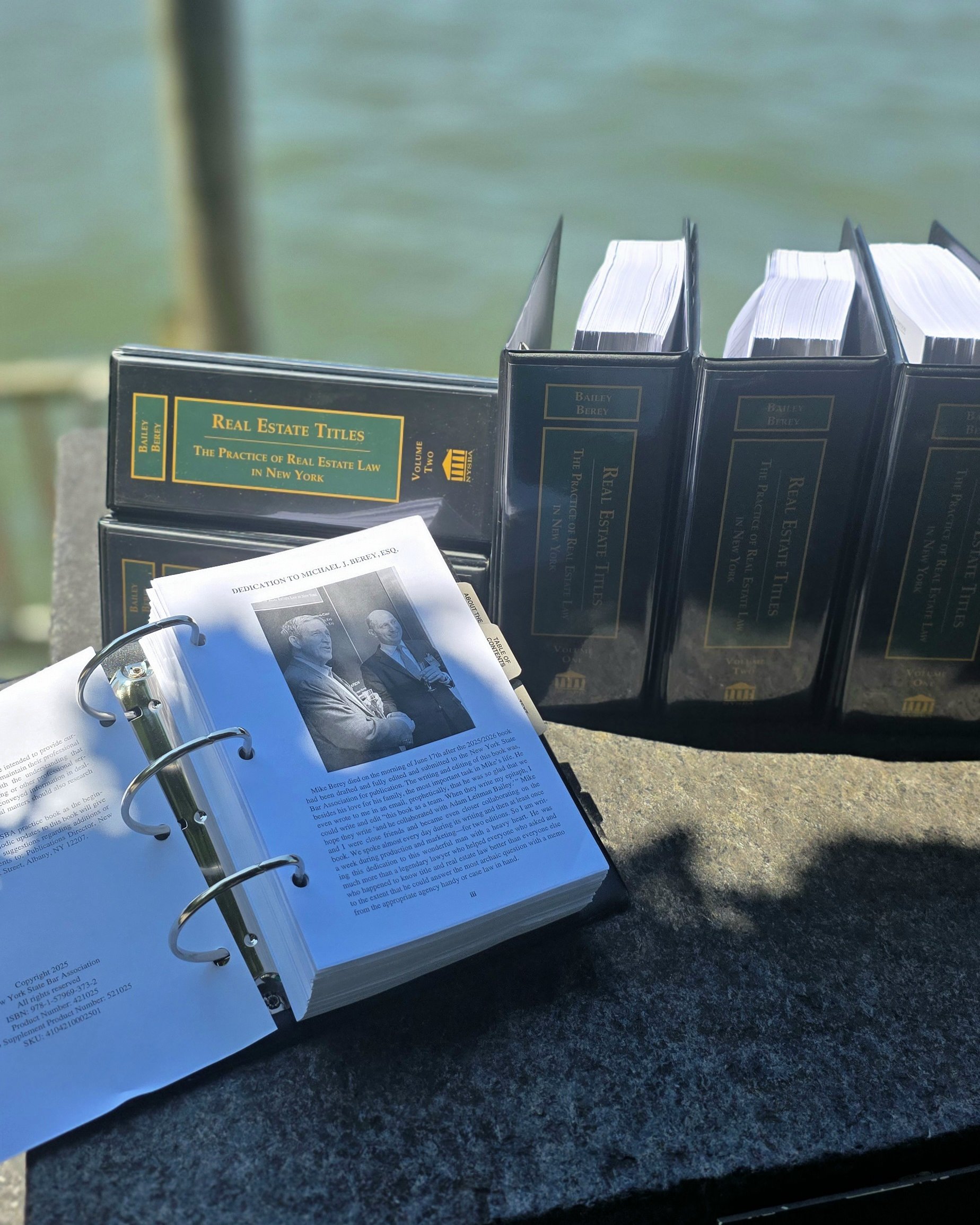
New York State Bar Association Releases Updated Edition of Real Estate Titles: The Practice of Real Estate Law in New York

By Jennifer Andrus
The New York State Bar Association announces the release of the newly revised edition of Real Estate Titles: The Practice of Real Estate Law in New York. The 5th edition of this reference book is an invaluable resource for all real estate professionals. Written and updated by many of the leading real estate practitioners and dedicated to co-author, Michael J. Berey, this title’s in-depth coverage is unparalleled in this area of practice. This book is the all-time best-selling book ever sold by the New York State Bar Association.
All aspects of real estate transactions are covered in 34 chapters, including contracts of sale, title search, mortgages, deeds, liens and real estate financing. All practitioners will benefit from this publication, from the beginning real estate practitioner to those dealing with the most complex issues.
This edition is dedicated to the memory of co-author Michael J. Berey who died shortly before it was released. Adam Leitman Bailey pays loving tribute to his friend and co-author.
“A tremendous loss for the legal community but at the same time Mike Berey poured himself and his time into writing and editing Real Estate Titles and leaves behind what I am sure he considered the greatest book on real estate law every written,” he wrote. “I am the one truly honored to write, edit and collaborate with a legend and master of real estate law–my good friend Mike Berey. And I am so glad that we have Real Estate Titles–not only to remember him by but to continue to learn from his teachings.”
“Mike was our Oracle,” added real estate attorney and friend Richard Fries. “His mastery of real estate law, title, tax, administrative law, statutes and regulations was legendary.”
Real Estate Titles: The Practice of Real Estate Law in New York, edited by Adam Leitman Bailey and Michael Berey, is available as a free e-book as part of your New York State Bar Association membership. A print edition is also available to members at a discounted rate. NYSBA membership includes access to our full library of e-books and hundreds of online forms, at no additional charge.



The Manhattan House Condominium Conversion: The Tenants’ Tale of a Multi-Year Saga of Living During Construction and the Law Firm that Made It Peaceful and Successful

By Laurie Villanueva
When developers start to change historical buildings, we often focus solely on the masterminds behind the reimagination of the old into the new. But in the case of the $1.1 billion Manhattan House condominium conversion, one of the most expensive conversions in New York City history, Adam Leitman Bailey, P.C. ushered the building’s occupants into a brighter future through extensive years-long litigation in all stages of the conversion.
Prolific developer Jeremiah W. O’Connor knew a condominium conversion of Manhattan House was worth a hefty investment.
Since its construction in 1951, the 21-story building occupying an entire city block and designated as a New York City landmark with almost 600 total units, has housed many notable New Yorkers, including former New York Governor Hugh Carey, the “King of Swing” jazz clarinetist Benny Goodman, and the actress and Princess of Monaco Grace Kelly. At the time that Kalikow, partnering with the late investor Jeremiah O’Connor, began the development project, even Brooklyn Dodgers legend Jackie Robinson’s family still lived in the building.
O’Connor had lofty ambitions for their conversion. Soon after the construction was completed and amid the mid-2000s financial crisis, they were listing condo sales at the average asking price of $1,775 per square foot.
But the rent regulated tenants, most of whom were middle-class renters who had lived there for decades, were afraid of being left behind. The costly conversion had the potential to completely upend the lives of the 600+ tenants occupying the building, and in many cases, the developers wanted them gone. They needed Adam Leitman Bailey, P.C., a scrappy firm that could match the ambitions of the prolific developers, to ensure the rights of both the free-market tenants and the rent-regulated tenants were not encroached upon, and that their quality of living was upheld through their building quite literally being torn apart.
To the developers attempting to bring a traditionally working-class building community into a new, luxury-minded market, the over 500 rent-regulated tenants represented Adam Leitman Bailey, P.C. were often seen as an inconvenience.
But, for the rent-regulated tenants in Manhattan House, the building was more than just somewhere to put their heads at night: it was the place they had called home for decades. By the time Manhattan House sold to O’Connor in 2005, most of the regulated tenants were more than 50 years old and long-time veterans of the building. They were immediately targeted by the developers, who were eager to deregulate the over 500 rent-stabilized units and maximize their profit.
The developers’ legal team attempted to drive rent-regulated tenants out of Manhattan House by weaponizing Major Capital Improvement (MCI) applications to justify rent increases and deny the tenants basic services. Their efforts to “improve” these apartments were at one point so egregious that they replaced boilers that were in perfect working condition.
In a letter to the developers on December 17, 2012, the rent-regulated tenants claimed that the new owners were aggressively attempting to raise the rents on stabilized units above the “luxury decontrol” threshold of $2,000/month, a move that would increase condominium sales while making current stabilized tenants ineligible for rent-regulation.
The developers continued their MCI application efforts, switching out many of the units’ in-shape windows for new panes that severely worsened living conditions by failing to block out almost any extreme temperatures. Further, the tenants called the owner’s denial of basic services systematic, as tenants faced pressure to leave the building after dealing with hot water failures, flooding, mold, bed bug infestations, heating outages, and sludge-filled water, all of which was exacerbated by heavy construction for the conversion straining the building.
One tenant, who had lived there for 25 years, came home to three feet of floodwater in her unit and was wrongfully charged $8,000 in water fees. Another woman who had lived in Manhattan House for 50 years was forced out of her unit and into a hotel while developers made “mandatory” window replacements. Longtime tenants were not only disrupted by constant construction and repairs within their units, but also lost access to critical building amenities as perpetual construction shut down the laundry rooms and elevators, and left hallways in disrepair.
Adam Leitman Bailey, P.C. refused to allow this gross assault on the rent regulated and free market tenants. The firm documented and challenged the strategic negligence, and fought false claims in Major Capital Improvement (MCI) applications, including identifying an engineering report that revealed the original boilers were in good condition and would last another 5-7 more years. The faulty application claimed the boilers were 25 years old, despite cast iron boilers having a useful life of 35 years, and defied the Useful Life Schedule in the Rent Stabilization Code.
Adam Leitman Bailey gave each tenant complaint its full attention, working tirelessly to address each of the issues as they arose. When a clause was added to the condominium bylaws allowing the landlords to evict any rent-regulated tenant who smoked in their unit or common area, Adam Leitman Bailey, P.C. defended tenants’ rights and argued that such a rule was designed to simply always keep the tenants on their toes, not in the sincere interest of safety.
When slews of MCIs attempted to spike or raise the tenants’ rent, the firm defeated the applications and secured a month off of rent and a rent reduction. The litigation team also negotiated additional protections for the tenants, convincing the building owners to allow pets and negotiated a construction schedule that did not interfere with the tenant’s peaceful living. The firm also ensured all repairs in the building were completed within 30 days, and that its legal fees were paid in full. Adam Leitman Bailey, P.C. prevailed on behalf of rent-stabilized tenants, defending and protecting their rights within Manhattan House.
In the case of Manhattan House’s market-rate tenants, many found themselves in a uniquely vulnerable position during the conversion, as they lacked the statutory protections their rent-regulated counterparts enjoyed. The developers knew this, and in most cases offered lease renewals doubling or even tripling the tenants’ rent to stay in their units.
One tenant, who was initially paying $4,500 per month in one year, was offered a new lease for $6,700 per month in 4 years later with no option to renew their current lease. The landlords added insult to injury by refusing to negotiate fair lease terms, instead moving rapidly to evict any tenant who did not accept their new offer.
The developers had little regard for the longtime tenants’ circumstances in their aggressive conversion. One tenant, who was suffering from Parkinson’s disease, faced eviction despite the special circumstances of his advanced age and deteriorating health. Another tenant, a 98-year-old man, was hospitalized several times following his exposure to construction dust and poor air quality. This was a direct result of his proximity to the ongoing repairs and renovations in the building, and the developers still sought to raise his rent or kick him out. Ignoring all personal circumstances and tenant histories in the building, the owners continued to offer market-rate tenant renewals with exorbitant rent increases.
Adam Leitman Bailey, P.C. faced an uphill legal battle once the tenants’ leases expired, but remained unwavering in its commitment to defend the free-market tenants, strategically extending legal proceedings to protect their rights and give them critical time to secure new housing and opportunities.
Beginning in June after the free-market lease expirations, the new landlords initiated holdover eviction proceedings against dozens of longtime Manhattan House market-rate tenants.
When many other firms would have stopped litigating at this loss and started strategizing their exit, Adam Leitman Bailey, P.C. knew the tenants did not have their proper day in court. The team devised a novel legal argument, drafting papers that proved the landlord’s counsel and the judge, collectively, did not properly address their argument of systematic retaliatory eviction claims in the first lower court case and appeal. A second judge sided with the tenants, and Adam Leitman Bailey, P.C. was able to renew the case for litigation, and buy the tenants precious time to seek better living arrangements.
Defending these tenants required a high-level legal strategy, and Adam Leitman Bailey P.C. began filing subpoenas to pursue retaliatory eviction claims. The firm filed subpoenas for the production of documents to MH Residential 1, LLC, investigating emails from employees and directors of Manhattan House to attempt to prove a pattern of bias against the market-rate tenants. The new owners attempted to dodge this subpoena, but the court ruled in favor of Adam Leitman Bailey, P.C., demanding that they produce the aforementioned documents. This led to our victory in an Appellate case to expand discovery, a huge win for the tenants and Adam Leitman Bailey, P.C.. This helped to build a detailed record of the tenant mistreatment and landlord misconduct occurring within the conversion at Manhattan House.
Adam Leitman Bailey, P.C. attorneys were determined to demonstrate the retaliatory nature of these evictions, highlighting how many of the recent evictions followed tenants’ involvement in tenant organizations or came right after they filed a complaint about poor conditions. The Developer-landlord took these eviction cases to court but the tenants’ faced a setback when the judge limited the scope of evidence acceptable to the record at trial. This limitation allowed witnesses to testify only about events between the building’s acquisition and the start of actions against them, excluding evidence of patterns like asbestos dust and retributive conduct.
The firm responded by filing a motion to reargue the decision limiting subpoena testimony, and submitted an order to show cause to stay the trial pending both that motion and our appeal to the Appellate Term. Further, we used valuation data, commissioned by our firm, to prove that rent trends in Manhattan compared unfavorably to the tenant group. This data found that the adjustments the tenant group faced led them to overpay beyond the neighborhood’s standard rent increases. The evidence also showed that certain long-term famous tenants received favorable rents compared to the general population. The judges and the Firm both knew that the maximum time the free-market tenants could receive if the tenant’s won their retaliatory evictions claims equaled to an additional one-year term. The free-market tenants litigation lasted 7 years without rent increases and while the tenants’ remained in possession.
After nearly 7 years of litigation, the landlord finally came to the table for settlement negotiations by the end of the non-jury trial. This opened the door for a number of market-rate tenants to purchase their units, freed the tenants from owning any back pay to the Developer-landlord and was the beginning of the end of a tiring and frustrating legal process for these tenants. Overall, the Developer did an excellent job making sure that the all tenants lived peacefully despite the construction ongoing turning Manhattan House into a state of the art, luxury building with new amenities that commanded top of the market prices.

What Good Boards Get Right
By Kate Mattiace
Efficient condo and co-op boards make a building run smoothly—but the most effective ones don’t work alone; they understand how to work together with other industry professionals, including property managers, attorneys, accountants, and others. What do the best boards have in common? And how can professionals tell when they’re working with a collaborative board versus one in need of improvement?
[…]
Being open to hear a range of perspectives and taking into account everyone’s views also helps boards make the best decisions. Board members are humans and come in with different personalities, preferences, and approaches, of course, but, says Manhattan-based real estate attorney Adam Leitman Bailey, “The flow of uninterrupted communication and respect for ideas cannot be underestimated. Insults and criticism should be left outside the meeting room. They can kill a good board from getting things done.”

Zillionaire defeats zillionaire in 740 Park renovation noise spat
By Will Parker
Judge orders Oaktree Capital head Howard Marks to knock it off.
Even in New York City, all the money in the world can’t buy you peace and quiet.
Hamburg Tang, the 85-year-old disgruntled semiconductor tycoon who sued billionaire neighbor Howard Marks and the 740 Park Avenue co-op board over noisy renovations, has won an order from a New York Supreme Court judge to limit the the amount of time per day Marks can carry out his now years long construction work.
[…]
The Tangs’ attorney, Adam Leitman Bailey, went as far as to suggest that the co-op board showed racial bias towards the Tangs, who are of Chinese descent. “We realized the board is a white man’s billionaire’s club,” he told the New York Post on Monday. “They were not treated with the same respect as others.”
[…]
-5b0c01e6abe1c04268b6ed1cab2b7a0f818d1dd5.png?v=09082025234804)
Condo Residents Seek Remedy for Neighbor’s Smoking Near School
A New York City condominium building stands next to an elementary school. City and state smoking laws require a 100-foot smoke-free perimeter around school entrances. This would include the sidewalk in front of the neighboring condo for at least 25 feet in both directions from the entrance. A board member and his spouse, in spite of complaints from multiple residents and the no-smoking signs posted by the city Health Department, regularly smoke directly in front of the condo’s entry. The smoke drifts into the lobby when the doors are open. What can unit-owners do?

Can You Stop People From Smoking Outside Your Building?
By Jill Terreri Ramos
Q: I live in a condo building in New York City that is next to an elementary school. I understand that city and state smoking laws require a 100-foot smoke-free perimeter around school entrances. This would include the sidewalk in front of my building for at least 25 feet in both directions from our entrance. A board member and their spouse, in spite of complaints from multiple residents and the no-smoking signs posted by the city health department, regularly smoke directly in front of our entry. The smoke drifts into the lobby when the doors are open. What can we do?
[…]
City law prohibits smoking in indoor common areas of buildings, though it’s not clear if a secondhand smoke case can be made in your situation. But there are other avenues. The smoking could create a violation of the housing maintenance code if the smoke interferes with the peaceful living of residents, or it could create a nuisance case, both of which could be brought in State Supreme Court, said Adam Leitman Bailey, a real estate attorney. Start by checking the board’s policies and writing a letter to the board about the drifting smoke.
“Court will work, but it’s expensive,” Mr. Bailey said. “Even when buildings can afford it, why waste your money when there are other methods that are less expensive?”
[…]

City Beekeepers: The Dos and Don’ts of Maintaining an Urban Hive
It’s perfectly legal to keep registered honeybee hives in the city, but they can’t become a nuisance to the neighbors.
Q: We live in a building on the Upper West Side. Bees from an unregistered bee hive at a neighboring building are getting through our window screens and into the apartments. I’m all for urban rooftop beekeeping, but the location of this hive — on a relatively low roof surrounded by much taller buildings — is problematic. I called 311 last summer, which referred me to the city’s Department of Health. It came out for an inspection in November, but the hives are now active again and the situation persists. What action we can take?
[…]
If all else fails, your building can file a private nuisance lawsuit against the beekeeper in State Supreme Court. The lawsuit should demand that the beekeeper legalize the hives and comply with city code, and cease operations until that happens, said Adam Leitman Bailey, a real estate lawyer in Manhattan.
Q&A: Airbnb Rental = Sublet?
Q. My co-op recently fined me $3k after they accused me of “subletting “ my apartment when, in fact, I was renting my spare bedroom on Airbnb—all along while I lived in the apartment. I was granted my registration number from the OSE in NYC. Can they impose a “sublet” fine even though I am in the apartment?
—Fined for Subletting
A. Manhattan-based attorney Adam Leitman Bailey says the writer seems to be in violation of the cooperative’s sublease policy prohibiting shareholders from renting out their apartments. “If this person was only paying enough to share utilities and expenses then she may be protected by New York Law’s roommate law. However, in this case she is profiteering off of renting out her apartment and not protected by any Housing Law and in violation of the co-op’s rules. Living with the roommate does not protect her, and the listing with Airbnb only worsens her case.”
Adam Leitman Bailey, P.C. Has Been Featured in the ‘Best Lawyers in America’ Edition for the Twelfth Year in a Row

We are delighted to announce that Adam Leitman Bailey and Jeffrey R. Metz have been recognized by our peers in the 32nd edition of The Best Lawyers in America® for their exceptional work in Real Estate Law. Best Lawyers released their 2026 recognitions here.
Additionally, four other Adam Leitman Bailey, P.C. attorneys have been featured on the Ones to Watch in America List
- Courtney J. Lerias (Recognized in Best Lawyers: Ones to Watch in America since 2021)
- Litigation - Real Estate
- Joanna C. Peck (Recognized in Best Lawyers: Ones to Watch in America since 2021)
- Litigation - Real Estate
- Danny Ramrattan (Recognized in Best Lawyers: Ones to Watch in America since 2021)
- Litigation - Real Estate
- Rachel Sigmund McGinley (Recognized in Best Lawyers: Ones to Watch in America since 2021)
- Litigation - Real Estate
- Real Estate Law

For over 40 years, Best Lawyers has been esteemed by both legal professionals and the public as a premier benchmark for legal integrity and distinction in the United States. Consequently, being recognized by Best Lawyers is a testament to exceptional practice.
The edition upholds the tradition of recognizing outstanding legal talent through a rigorous peer-review process, ensuring that the awarded lawyers meet the highest standards of professional excellence. In a saturated market, clients need confidence that the very best in the industry are handling their most critical matters. Those who receive high peer reviews undergo a thorough verification process to ensure they are currently still in private practice. Only then can these top lawyers be recognized by Best Lawyers, and for eleven years now, Mr. Bailey has.
As a reputable resource for both clients and legal professionals, this edition not only highlights individual achievements but also reflects the evolving nature of the legal industry, emphasizing the importance of integrity, skill and dedication in legal practice.
From Best Lawyers:
“Inclusion in The Best Lawyers in America® is determined through a comprehensive peer-review survey. The 32nd edition reached a historic milestone with over 250,000 voters having participated in our voting process since we began asking the very best: “If you are unable to take a case, how likely would you be to refer your client to this lawyer?” To create the awards over 23 million evaluations were analyzed including a record breaking 3 million responses from this year alone. Our commitment to our industry-driven, purely peer-based review process is central to our philosophy, as we believe that the top lawyers are best suited to identify their peers at the highest level.”
Adam Leitman Bailey, P.C. Ranked as an Outstanding Law Firm by The Lawyers Global 2025

Adam Leitman Bailey, P.C. is thrilled to share its achievement of an outstanding law firm for The Lawyers Global 2025 awards. The firm’s results-driven mindset, augmented by aggressive litigation and client-centric practices, has led to great success in the New York State real estate law environment. The Lawyers Global awards tout the firm’s latest examples of success.
From Lawyers Global:
"By uniting many of the best real estate attorneys of its generation, Adam Leitman Bailey, P.C. has become one of New York’s most prominent real estate law firms. The firm excels by solely practicing real estate law and only taking on projects and cases where it is among the best in the field. Adam Leitman Bailey, P.C. has achieved groundbreaking results in the courtroom, in the board room, at the closing table, in the lobbies of legislative bodies, and in every other venue where talented legal advocacy is key to its clients’ interests.
The firm has participated and prevailed in many of the most important New York real estate cases of the new millennium, as reflected in numerous published and unpublished decisions on novel legal issues. Some of these notable victories have changed the landscape of New York law. The firm has invented new ways to practice law and new theories to solve its clients’ problems. Its successes have resulted in producing new laws and new precedents, creating new leases to become the industry standards, devising new faster, less expensive procedures to obtain foreclosures and evictions, using “Perry Mason” moments to win trials, creating out-of-the-box ways to collect on judgments, and creating new theories of law to obtain justice for clients.
A New York State Judge wrote that Adam Leitman Bailey “was the best trial lawyer I saw in my nine years as a judge in New York City.” A New York State Judge, Kings County, stated that he had known Adam Leitman Bailey, P.C. for fifteen years and “that [it] is a brilliant law [firm] and innovative who always worked zealously on behalf of his clients.”
When Adam Leitman Bailey, P.C. used a forgotten statute to prevail in a landmark case, The Wall Street Journal quoted a prominent New York developer’s attorney who called the holding a “game-changer” affecting real estate nationwide.
The New York Times referred to his legal strategy and legislation, proposed in one case, as “novel.” In addition, The New York Times remarked on another case in which “Adam Leitman Bailey fought on…grinding through excruciating detail and obscure Perry Mason moments.” A different case was described as “the city’s largest condo refund ever” (Curbed NY). In another transaction, Adam Leitman Bailey obtained the largest government grant ($21 million) for a cooperative in New York history. More recently, Adam Leitman Bailey secured the largest settlement in New York City history for a property-casualty lawsuit. The Commercial Observer ranked one of the firm's victories among their “15 Most Fascinating New York Real Estate Cases of the 21st Century.”
The collective experience of this team has been responsible for winning several landmark decisions in real estate law. These attorneys have had more appellate victories at the Court of Appeals and its subsidiary appellate courts than most real estate firms have had cases of any kind, won or lost. Its trial attorneys have won hundreds of cases, both with and without juries. The attorneys at Adam Leitman Bailey, P.C. have won over a thousand cases in state, federal, and housing court, including over 400 appellate court cases, many at New York’s highest court, the Court of Appeals.
Proud of its past, Adam Leitman Bailey, P.C. aggressively pursues its future so it may continue to bring to its clients the best that any law firm can offer, both in advocating on behalf of the client and in working with the client.
For prices, fees, pricing models, scheduling an appointment, or any other questions, contact Adam Leitman Bailey, P.C."

Adam Leitman Bailey Has Been Named as a 500 Leading Real Estate Lawyer by Lawdragon for 2025
By Katrina Dewey
We’re thrilled to announce that Adam Leitman Bailey has been featured on The 2025 Lawdragon 500 Leading Global Real Estate Lawyers list. Adam Leitman Bailey is one of only four attorneys based in New York on the list, and the only attorney from a firm with fewer than 39 attorneys.
From Lawdragon:
"We’re delighted to introduce The 2025 Lawdragon 500 Leading Real Estate Lawyers. This is the 2nd edition of this guide to advisors who specialize in a vast range of skills – development, finance, leasing, litigation, REIT structuring – on a range of property that can range from a tricky environmental site outside San Diego to a megadevelopment for an energy company in the Middle East to a troubled Manhattan skyscraper converting from commercial to residential. From the development and careful handling of a sublime tropical paradise to the redevelopment of JFK International Airport, these are the lawyers you need to know."

Crain’s Names Adam Leitman Bailey, P.C., As the Second Best Law Firm to Work for in NYC with Under 50 Employees. This is the 7th Time Adam Leitman Bailey, P.C., Has Won This Award.


“They are the best in the industry and I only want to work with the best” – Jay Batra

“That shows the kind of mentorship and tailoring of the experience that we get at Adam Leitman Bailey, P.C.” – Emily, Paralegal

“I am really treated like a first-year associate essentially” – Richard, Summer Associate

“Based on the firm’s prestige and everybody here, I would 100% recommend the Summer Associate position” – Vincenzo, Summer Associate

“It was really impactful for me, as someone on the pre-law track, to see that you can be compassionate and still work in law; that really stood out to me” – Cate, Marketing Intern

“I learned a lot of different skills at this internship. Getting to work alongside the best legal professionals in New York has been really amazing for me” – Allyson, Summer Intern

“The first day I walked in, I thought I would be intimidated by such powerful attorneys but they all welcomed me” – Aliyah, High School Intern
Adam Leitman Bailey, P.C.'s Summer Boat Party
Seeing the land we have given so much to build and to fight for justice, from the water. Stepping back, we saw that our work created a bond among the Firm and an appreciation for New York City’s history and the freedoms earned by hard-working men and women. For one night, instead of working on the dirt, we appreciated the land from the water. And in our hearts, we were inspired and knew how blessed we are.
Then we came face to face with the Statue of Liberty—our hearts pounded. One of us began reciting Emma Lazarus’s poem 'The New Colossus', which, in part, is inscribed on the Statue. Others were silent—reflecting on its meaning and its beauty.


State Supreme Court in the Eyes of a High School Intern
